| Difficulty Level: |
 |
very simple |
Parts and Tools
- Petri dish
- OHP film
- Enamel paint or Tippex
- Paint brush
|
- Disc of paper from a hole punch
- 2p piece
- PVA glue
|
Instructions
This model can be used in biology lessons which deal with antibiotic resistance and provide a foolproof way of demonstrating the principle again and again without failure.
Students traditionally seed an agar filled Petri dish with a bacteria, place upon the agar surface an antibiotic disc and wait for the bacteria to colonise the agar. As the bacteria multiplies, a clear area around the antibiotic disc should become visible where the bacteria cannot survive.
This model consists of a Petri dish with a fake bacteria colony inside. The bacteria is actually paint or Tippex and the 'antibiotic disc' actually a disc of paper from a hole punch. Like a real colony, a space around the disc shows how the antibiotic disc has 'killed' the bacteria.
The benefit of this model is that there are no health and safety implications associated with it so the dish can be passed around the class for observation. Also the dish can be used again and again without need to create a new colony each time. The model is not designed to be completely lifelike but represents the actual article in an accurate way and can therefore be used in teaching in the same way as a genuine seeded plate.
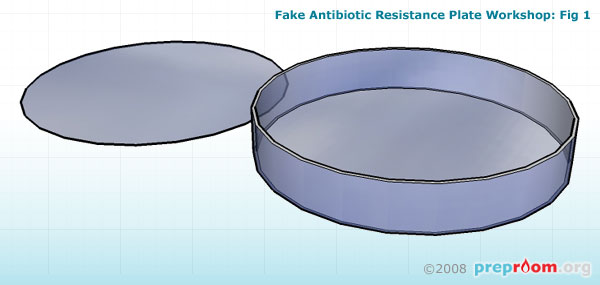
Fig 1: Petri dish and OHP film
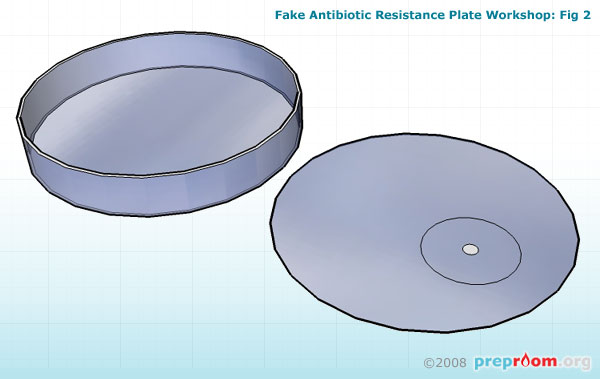
Fig 2: Glue 2 pence sized paper disc onto the film
Take a Petri dish (see fig 1) and cut a circle from the OHP film that will fit inside the main body of the dish. Glue to the film a hole-punched disc of paper using PVA glue (see fig 2). Over the hole, place a two pence piece. In this diagram the 2p is transparent for clarity.
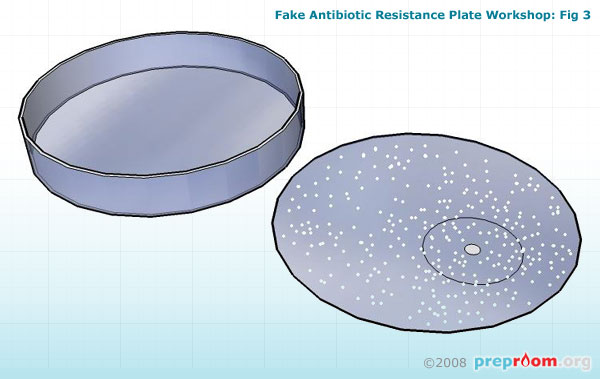
Fig 3: Apply enamel paint
Fig 3 shows how the paint should be applied. Enamel paint can be flicked using a paintbrush giving a thorough dappled effect or Tippex can be painted on to the film randomly. Try to make the paint look like a genuine bacterial colony by selecting the correct colours and similar dappled appearance.
Insert the OHP film into the Petri dish and remove the 2p once the paint has dried. You should now have a realistic looking colony.
To make the colony more realistic, a thick layer of PVA glue mixed with a hint of coloured acrylic paint can be poured into the Petri dish and left for several days to dry. This should look more like a layer of agar and the OHP film can be placed on top of this layer.
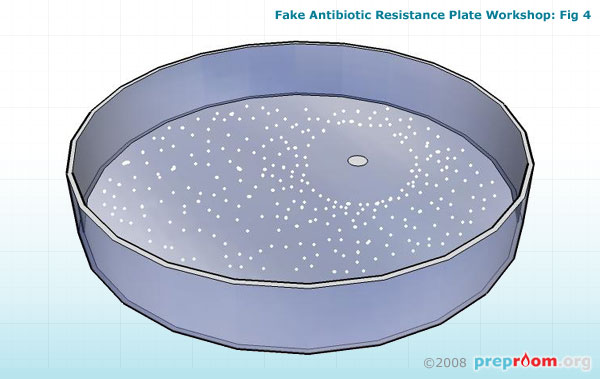
Fig 4: Finished dish
Finally place a lid on the Petri dish and seal with sticky tape.
Disclaimer
Before attempting any of the construction projects featured on this website, ensure you have, and know how to use, the appropriate tools, components and safety equipment and are competent to undertake the project. These guides are for information only and we hold no responsibility for any accidents, injuries or damage caused by the use or misuse of any equipment, project or information contained within this website. In short - use common sense and stay safe!